THE COMPANIES BUILDING THE CHIPS THAT POWER THE WORLD IN 2026
Metadescription: AI chips are transforming artificial intelligence. Discover how semiconductors, AI hardware and companies are shaping the future of AI.
Artificial intelligence is transforming every industry, from healthcare and finance to mobility and manufacturing. Yet behind every breakthrough lies a technology that rarely makes the headlines: AI chips.
As generative AI models become larger and more complex, semiconductors have emerged as one of the world's most strategic resources. The race to build AI hardware is no longer just a competition between technology companies—it is becoming a geopolitical contest that will shape the future of innovation.
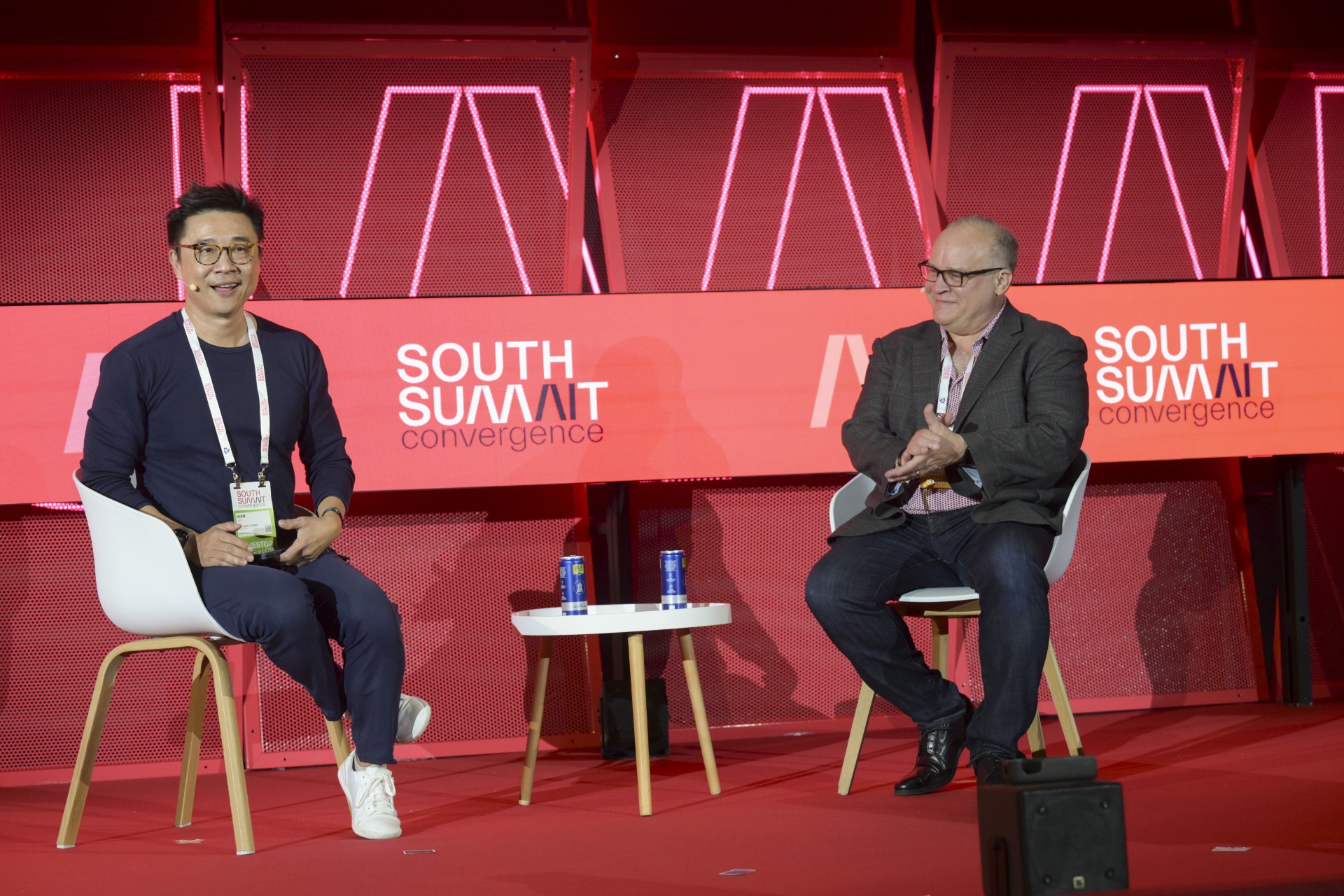
At South Summit Madrid 2026, Keith Witek, COO of Tenstorrent, and Hian Goh, Founding Partner of Openspace Capital, explored why the next chapter of artificial intelligence will be defined not only by software, but by the companies building the hardware that powers it.
Why chips have become the biggest bottleneck for artificial intelligence
While large language models (LLMs) have captured public attention, the infrastructure required to train and deploy them has become increasingly difficult and expensive to build.
According to Keith Witek, one of the industry's biggest misconceptions is that today's GPUs were originally created for artificial intelligence. “For more than 40 years, GPUs were designed to push pixels to a screen as fast as possible”.
That legacy architecture works remarkably well, but it was never intended to process the trillions of calculations required by modern AI models.
As demand for AI infrastructure continues to accelerate, traditional chip architectures are struggling to keep pace. This challenge is becoming one of the defining trends for the next generation of DeepTech startups.
GPU vs TPU: Why specialised AI hardware matters
The industry's response has been the development of Tensor Processing Units (TPUs) and other AI accelerators specifically designed for machine learning.
Google recognised this challenge as early as 2015, introducing its TPUs to optimise deep learning workloads. Unlike traditional GPUs, TPUs minimise memory bottlenecks and significantly improve computational efficiency.
Today, companies are going even further by designing entirely new AI accelerators capable of delivering higher performance without dramatically increasing infrastructure costs.
The next generation of AI chip companies
For years, Nvidia has dominated the AI chip market. But as artificial intelligence expands across industries, investors are increasingly looking beyond a single supplier.
Opening the discussion, Hian Goh explained the question guiding many of his recent investments: “Three years ago I asked myself: who could challenge Nvidia?”
Rather than identifying one direct competitor, the answer lies in a growing ecosystem of AI chip companies developing alternative architectures.
Among them is Tenstorrent, whose open-platform approach focuses on maximising performance while reducing dependence on expensive proprietary technologies.
Instead of relying solely on increasingly costly hardware, companies are redesigning both software and silicon to extract greater efficiency from existing semiconductor technologies.
This evolution is creating entirely new opportunities for AI startups and investors looking beyond software applications.
From monolithic chips to chiplets
One of the most significant innovations discussed at South Summit was the adoption of chiplets.
Traditional semiconductor development requires designing an entire processor as a single integrated unit—a process that can take three years or more.
Chiplets replace that model with smaller interconnected modules that can be upgraded independently.
For companies like Tenstorrent, this dramatically shortens development cycles, allowing new hardware generations to be released in as little as three to six months. This modular approach enables AI hardware innovation to move at a pace much closer to software development.
Open hardware versus proprietary ecosystems
Another central theme of the discussion was technological sovereignty. Witek used an automotive analogy to explain the difference between owning technology and simply using it.
Buying a premium vehicle provides access to its performance, but not to its engineering. The same principle applies to semiconductors.
Closed ecosystems such as Nvidia, Intel and Apple provide exceptional products but retain full control over their architectures. Open platforms enable developers to build upon existing designs, accelerating innovation across the AI hardware ecosystem.
What AI startups should learn from the chip race
For AI startups, the discussion offered an important strategic lesson. Infrastructure decisions made today will directly influence future scalability, operational costs and competitive advantage.
Hardware that appears cutting-edge today may quickly become obsolete as AI architectures continue evolving.
Witek illustrated this with his experience in autonomous driving. Autopilot 3 was designed around convolutional neural networks. Only months after deployment, transformer architectures emerged, requiring an entirely new hardware design for the following generation.
The lesson for founders is clear: flexibility matters. Rather than optimising exclusively for today's AI models, companies should build technology stacks capable of adapting to tomorrow's breakthroughs.
As Witek summarised, "you want to have roughly a B+ in everything. What you can't afford is to be missing a feature entirely."
This mindset is becoming increasingly relevant for founders participating in startup ecosystems such as South Summit.
Europe's opportunity in the AI hardware race
Europe possesses many of the ingredients required to become a global leader in AI hardware and semiconductor innovation.
With more than 450 million consumers, world-class engineering talent and growing public investment, the continent has the potential to strengthen its position within the semiconductor value chain.
According to Witek, Europe can learn from countries such as Singapore, Israel, Taiwan and the United Arab Emirates, where strategic public investment helped create globally competitive technology ecosystems.
The challenge is no longer simply funding startups. It is building the industrial capabilities required to manufacture the AI chips that will power the next generation of artificial intelligence.
This is also one of the major opportunities discussed across Europe's innovation ecosystem.
The future of AI will be built on silicon
Artificial intelligence may be transforming software, but its future depends on AI chips, semiconductors and the companies capable of designing the world's next generation of AI hardware.
The conversation at South Summit Madrid 2026 made one thing clear: the race for AI leadership will not be won by algorithms alone. It will be won by those building the silicon that makes those algorithms possible.
If you want to stay ahead of the trends shaping artificial intelligence, DeepTech and the global startup ecosystem, explore more insights on the South Summit blog and join the South Summit waiting list to be part of the conversations defining the future of technology.