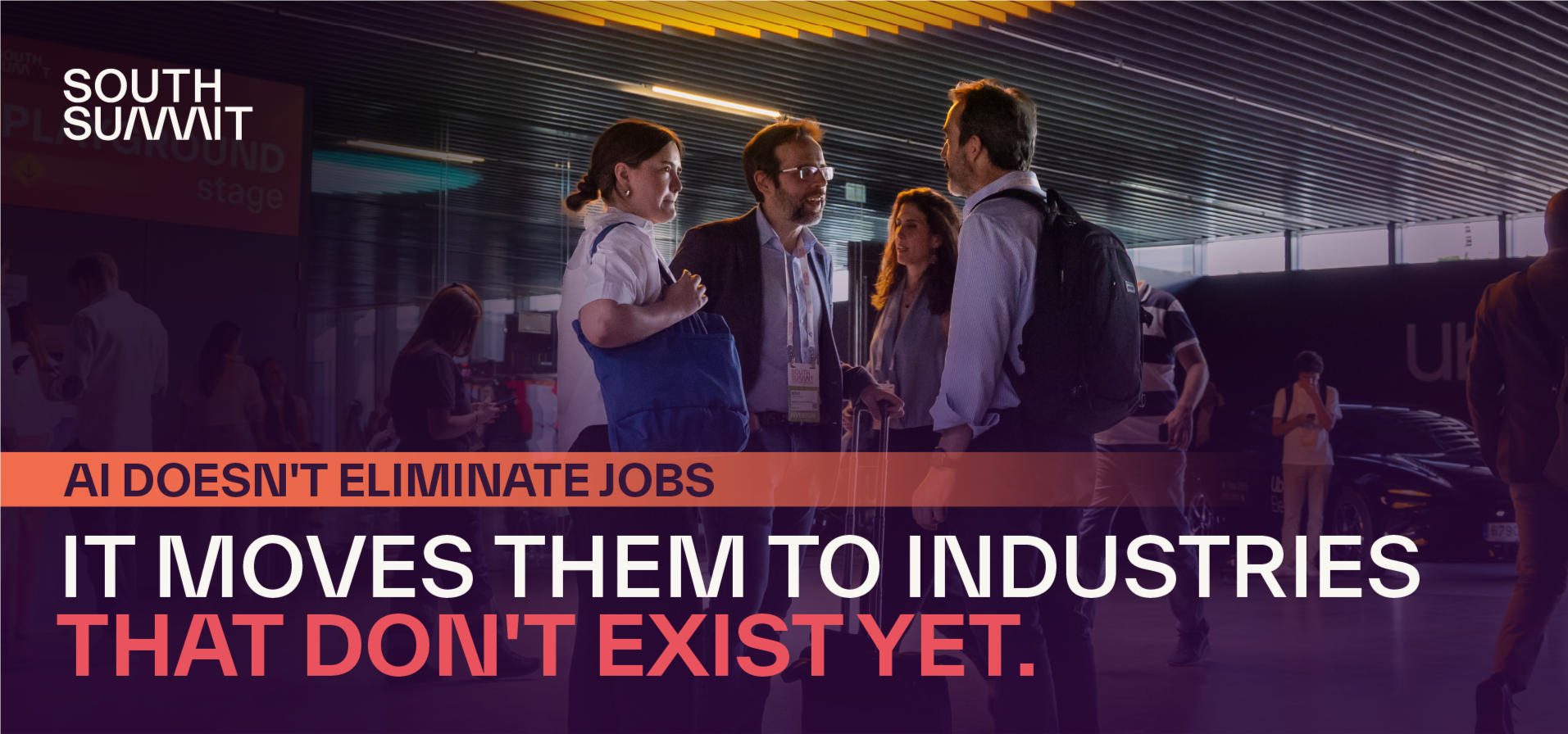
The conversation around artificial intelligence (AI) and employment often focuses on one question: Will AI replace workers? Most headlines emphasize automation, cost reduction, and job displacement across functions such as customer service, legal, finance, and administration.
However, history suggests a different outcome. Technological revolutions rarely eliminate work altogether. Instead, they reshape economies by moving talent into industries that previously didn't exist. The real impact of AI on business growth is not simply improving efficiency, it's creating entirely new markets, products, and opportunities.
For founders and investors, this means rethinking AI as more than a productivity tool. The competitive advantage of the next decade will come from using AI to discover and build businesses that were impossible just a few years ago.
Kamran Elahian's vision for AI-driven growth
During the keynote Beyond Convergence: Strategies for the Future Economy at South Summit Madrid 2026, Kamran Elahian, Chairman and Co-Founder of Innovera.ai, challenged the way many organizations are approaching AI.
According to Elahian, too many companies see AI primarily as a tool for reducing headcount and cutting operating costs. While automation can improve efficiency, this defensive mindset overlooks AI's greatest strength: enabling companies to create new sources of growth. As he put it: "AI is flooding the world with opportunities".
Rather than replacing talent, AI expands what talented teams are capable of building. Companies that succeed will be those that use AI to identify new markets, launch innovative products, and solve problems that were previously too expensive or complex to tackle.
Why AI creates more jobs than it replaces
The relationship between technology and employment is not new. Elahian illustrated this with one of history's clearest examples: the transition from horse-drawn transportation to the automobile. "In the 1920s, 2.5 million people worked in horse-drawn transportation. 50 years later, that number was zero. But about 20 million new jobs were created".
Those new jobs did not emerge within the horse industry. They appeared across completely new sectors, including:
● Automotive manufacturing
● Road infrastructure
● Fuel stations
● Vehicle maintenance
● Hospitality and roadside services
● Logistics and distribution
AI is likely to follow the same pattern. While some repetitive tasks will become automated, entirely new professions are already emerging around AI governance, data infrastructure, cybersecurity, autonomous systems, AI product management, and human-AI collaboration. Many future roles have not yet been defined.
AI is making business experimentation faster
One of the biggest barriers to innovation has traditionally been the cost of validating new business ideas.
Until recently, entering a new market often required months of research, expensive consulting projects, and strategic decisions based largely on assumptions. By the time the analysis was complete, economic conditions or regulations could already have changed.
AI is transforming this process. Modern AI-powered simulation tools allow companies to test multiple business scenarios simultaneously by analyzing variables such as:
● Market demand
● Macroeconomic conditions
● Regulatory changes
● Supply chain risks
● Logistics costs
● Competitive dynamics
Instead of waiting months for a market study, organizations can evaluate opportunities within hours and adapt their strategies in real time. This dramatically lowers the cost -and the risk- of innovation.
What AI means for startup growth
For startups, the impact is even greater. Young companies have traditionally faced limited resources when validating new products or entering new markets. Today, AI-powered market intelligence and simulation platforms give founders access to capabilities that were once available only to large corporations or consulting firms.
This changes how startups scale. Instead of relying solely on intuition, founders can rapidly test assumptions, eliminate weak ideas, and focus investment on opportunities supported by data.
The same analytical framework that venture capital firms use to evaluate startups (combining market size, product potential, team quality, go-to-market strategy, and financial performance) is increasingly available to entrepreneurs themselves.
As a result, startups can make faster, more informed decisions while reducing unnecessary spending during their early growth stages.
AI and business growth: the real opportunity
The biggest misconception about AI is that its primary value lies in replacing people. In reality, AI is expanding what organizations can achieve. By reducing the cost of experimentation, accelerating decision-making, and enabling entirely new business models, AI gives companies the ability to pursue opportunities that were previously out of reach.
The organizations that thrive in the AI era will not necessarily be those with the fewest employees, but those capable of combining human creativity with intelligent systems to build the next generation of industries.
The future of work is therefore less about replacing talent and more about redirecting it toward solving problems that, until now, no business had the tools to address. AI is not simply transforming existing jobs: it is creating the foundations of tomorrow's economy.
References
● South Summit Madrid 2026, session Beyond Convergence: Strategies for the Future Economy — Keynote by Kamran Elahian (Innovera.ai), Arena Stage.
● World Economic Forum. The Future of Jobs Report, analysis of labor transition and new technology sectors.
● PricewaterhouseCoopers (PwC) Global. AI Analysis Report: GDP impacts and job creation metrics.
● MIT Technology Review. How AI simulation models are changing corporate strategy and market validation.